▪︎ How to Turn a Job Description into a Powerful LNC Resume: A Nurse Attorney’s Guide for LNCs
As a nurse attorney who has trained hundreds of Legal Nurse Consultants (LNCs), I see the same mistake over and over again: nurses who list their nursing skills instead of revising them to reflect the legal skills attorneys are looking for in a LNC.
Nurses may read a job description and think, “I’ve never done that.”
But more often than not, they have—they just aren’t using the right language.
Today, I want to show you how to take the wording directly from a 2026 ad by an Arizona Law Firm looking for a LNC and use the job description to translate your nursing experience into a resume that clearly reflects those skills. (Click here to see the full Job Description.)
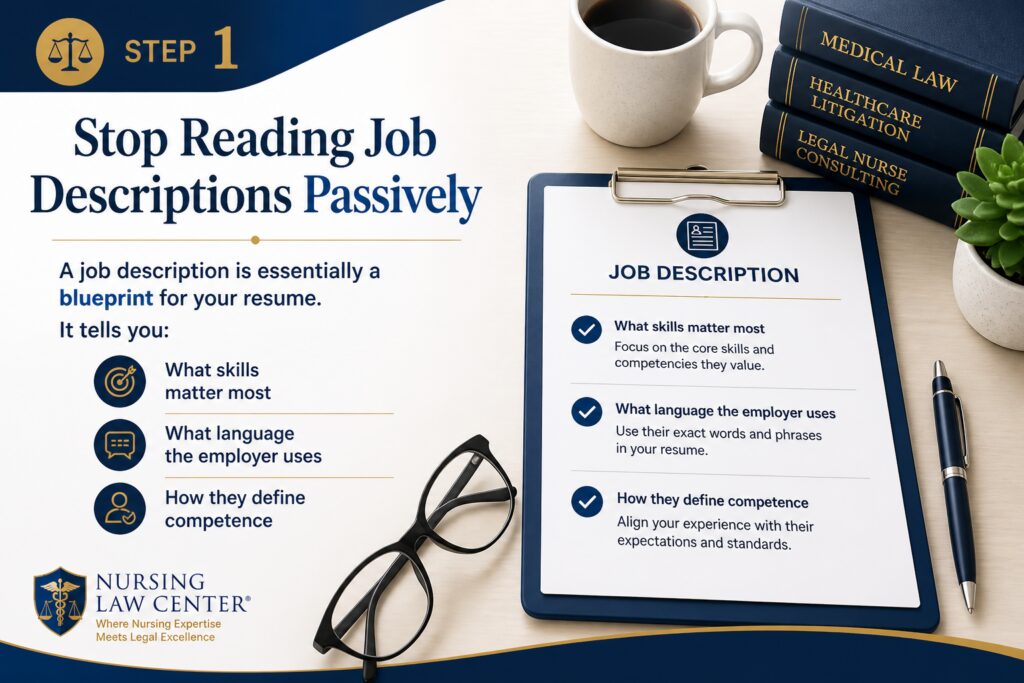
Step 1: Stop Reading Job Descriptions Passively
Most people skim job postings. That’s a missed opportunity.
- What skills matter most
- What language the employer uses
- How they define competence
A job description is essentially a blueprint for your resume. It tells you:
Instead of asking, “Do I qualify?”, ask:
“Where have I already demonstrated these skills in my nursing career?”
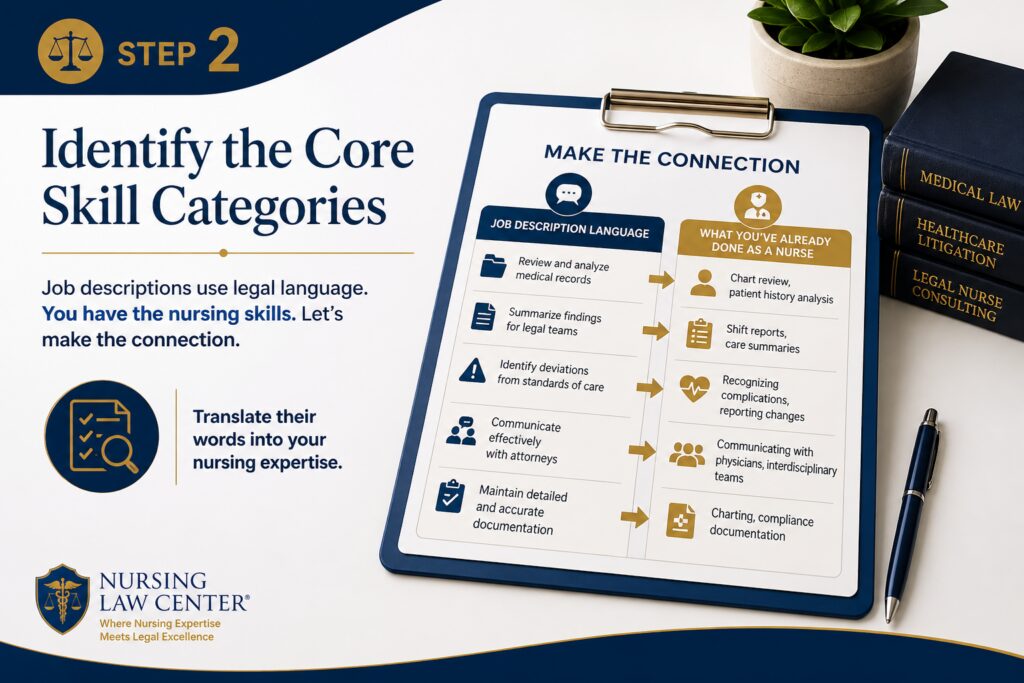
Step 2: Identify the Core Skill Categories
Let’s say a job description includes language like:
- “Review and analyze medical records”
- “Summarize findings for legal teams”
- “Identify deviations from standards of care”
- “Communicate effectively with attorneys”
- “Maintain detailed and accurate documentation”
These aren’t foreign skills—they’re nursing skills in a different context.
Here’s how they translate:
| Job Description Language | What You’ve Already Done as a Nurse |
| Review and analyze records | Chart review, patient history analysis |
| Summarize findings | Shift reports, care summaries |
| Identify deviations | Recognizing complications, reporting changes |
| Communicate with attorneys | Communicating with physicians, interdisciplinary teams |
| Maintain documentation | Charting, compliance documentation |
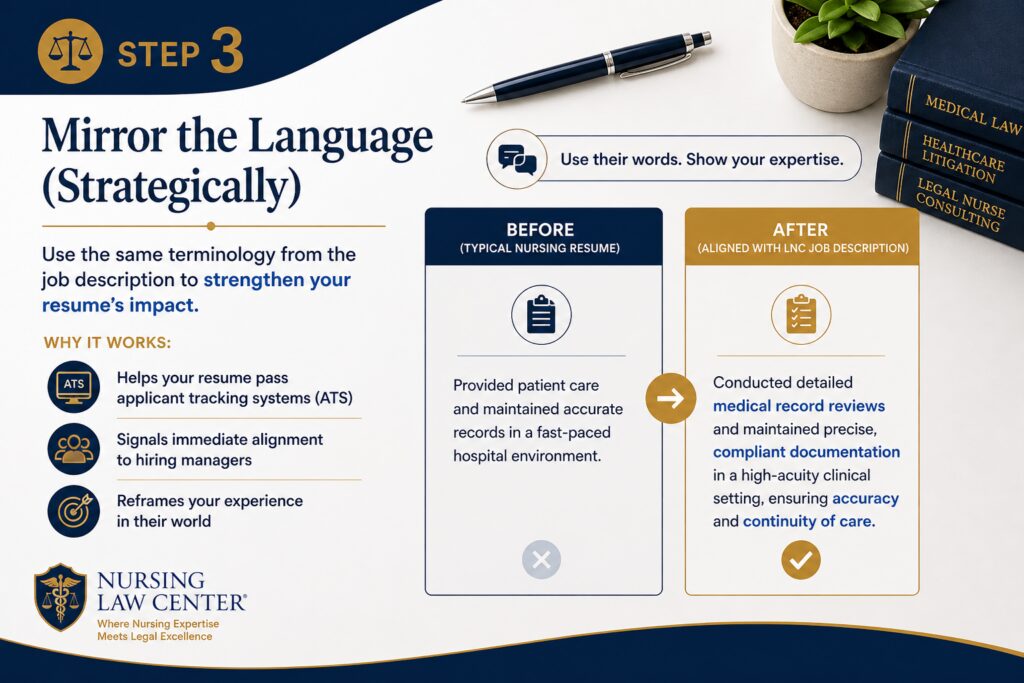
Step 3: Mirror the Language (Strategically)
One of the most effective resume techniques is mirroring—using the same terminology found in the job description.
Why? Because:
- It helps your resume pass applicant tracking systems (ATS)
- It signals immediate alignment to hiring managers
- It reframes your experience in their world
Example Transformation
Before (typical nursing resume):
Provided patient care and maintained accurate records in a fast-paced hospital environment.
After (aligned with LNC job description):
Conducted detailed medical record reviews and maintained precise, compliant documentation in a high-acuity clinical setting, ensuring accuracy and continuity of care.
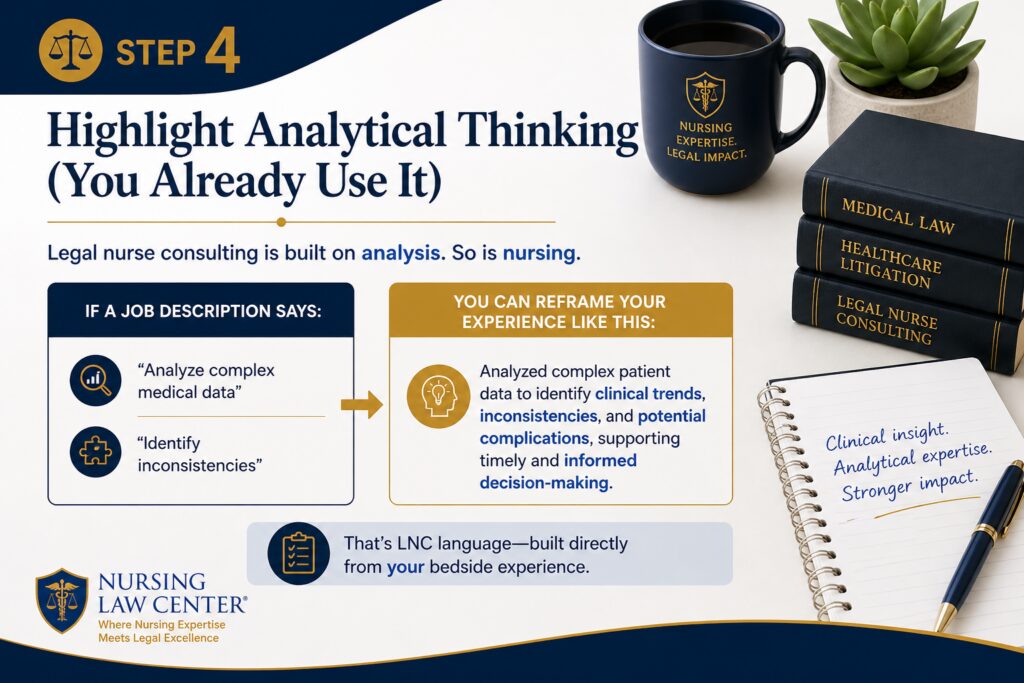
Step 4: Highlight Analytical Thinking (You Already Use It)
Legal nurse consulting is heavily focused on analysis, but so is nursing.
If a job description says:
- “Analyze complex medical data”
- “Identify inconsistencies”
You can reframe your experience like this:
Analyzed complex patient data to identify clinical trends, inconsistencies, and potential complications, supporting timely and informed decision-making.
That’s LNC language—built directly from bedside experience.
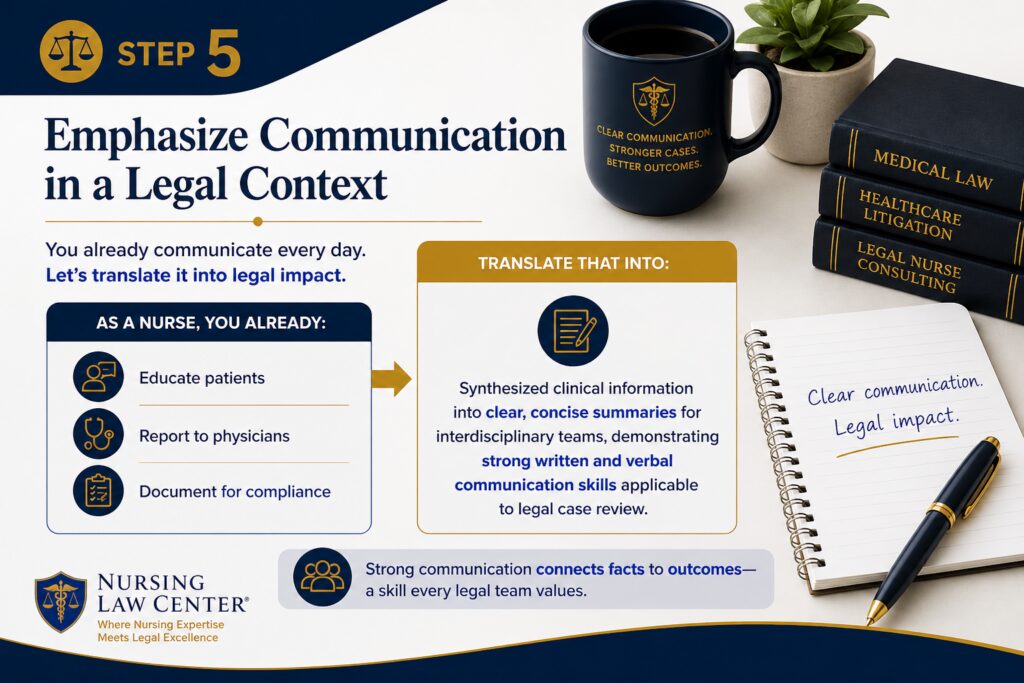
Step 5: Emphasize Communication in a Legal Context
Many job descriptions emphasize:
- “Communicate findings clearly”
- “Prepare reports for legal professionals”
As a nurse, you already:
- Educate patients
- Report to physicians
- Document for compliance
Translate that into:
Synthesized clinical information into clear, concise summaries for interdisciplinary teams, demonstrating strong written and verbal communication skills applicable to legal case review.
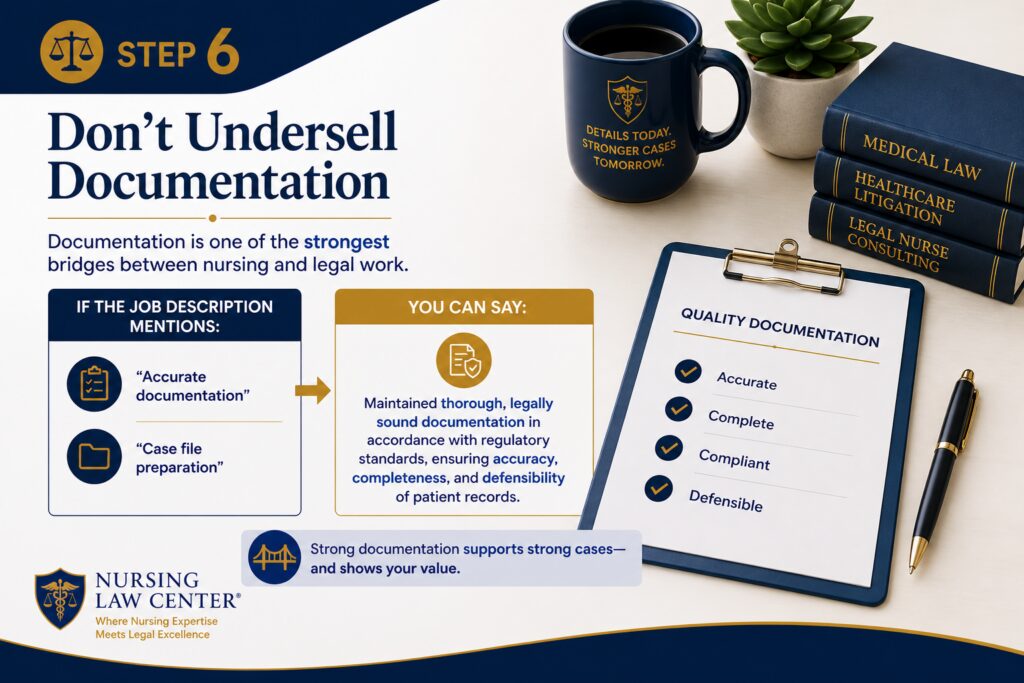
Step 6: Don’t Undersell Documentation
Documentation is one of the strongest bridges between nursing and legal work.
If the job description mentions:
- “Accurate documentation”
- “Case file preparation”
You can say:
Maintained thorough, legally sound documentation in accordance with regulatory standards, ensuring accuracy, completeness, and defensibility of patient records.
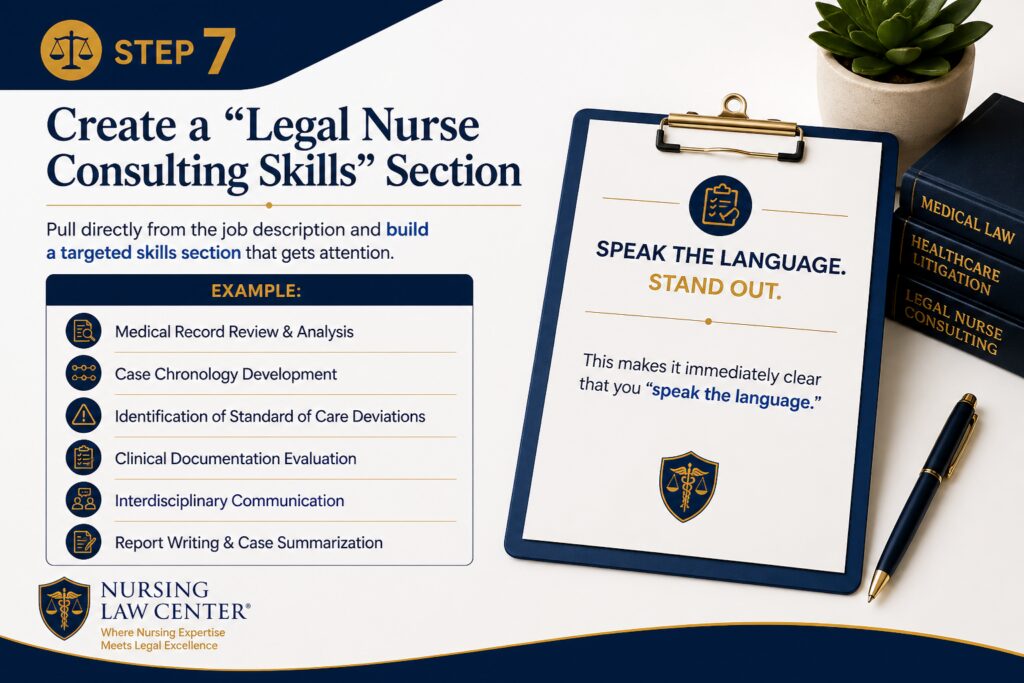
Step 7: Create a “Legal Nurse Consulting Skills” Section
Pull directly from the job description and build a targeted skills section:
Example:
- Medical Record Review & Analysis
- Case Chronology Development
- Identification of Standard of Care Deviations
- Clinical Documentation Evaluation
- Interdisciplinary Communication
- Report Writing & Case Summarization
This makes it immediately clear that you “speak the language.”
Final Thought: You’re Not Starting Over—You’re Reframing
One of the biggest mindset shifts I teach in my LNC training is this:
You are not transitioning into something completely new—you are translating what you already know into a new professional language.
The job description is your dictionary.
Use it.
Study it.
Mirror it.
And most importantly, trust that your nursing experience already contains the foundation—you just need to present it in a way that legal employers recognize.
If you’d like, share the specific job description you’re working from, and I can help you rewrite your resume bullet-by-bullet using this approach. You can check out all the LNC Training Programs I offer as well as the Advanced LNC Workshops with topics like Writing Your LNC Resume on my website with link below.

Writing and Polishing Your LNC Resume (3.2 CE Hours)
Watch the beginning of the first Advanced LNC Workshop Writing and Polishing Your LNC Resume!
CE credits are available for a $15 processing fee per certificate.
Sincerely,
Laurie R. Elston
Nursing Law Center
www.NursingLawCenter.com
Law Office of Laurie R. Elston Inc.
📞 T: (805) 481-1001
📧 Email: Elston@charter.net
